Overview
The Uplink Gateway connects existing IP cameras and DVR/NVR systems to VXG Cloud VMS without requiring software or firmware changes on the cameras. In most deployments, network and firewall changes are not necessary.
The Gateway runs on a separate device, such as a micro-router,
mini-PC, or server, connected to the same local network as the cameras. It initiates a secure outbound connection to the cloud over port 443 (HTTPS), without requiring port forwarding or inbound firewall rules.
How It Works
The Uplink Gateway connects to the same local network switch as the IP cameras and DVR/NVRs. The switch connects through the existing firewall and Internet modem/router to the Internet. The Gateway does not sit between the cameras and the Internet.
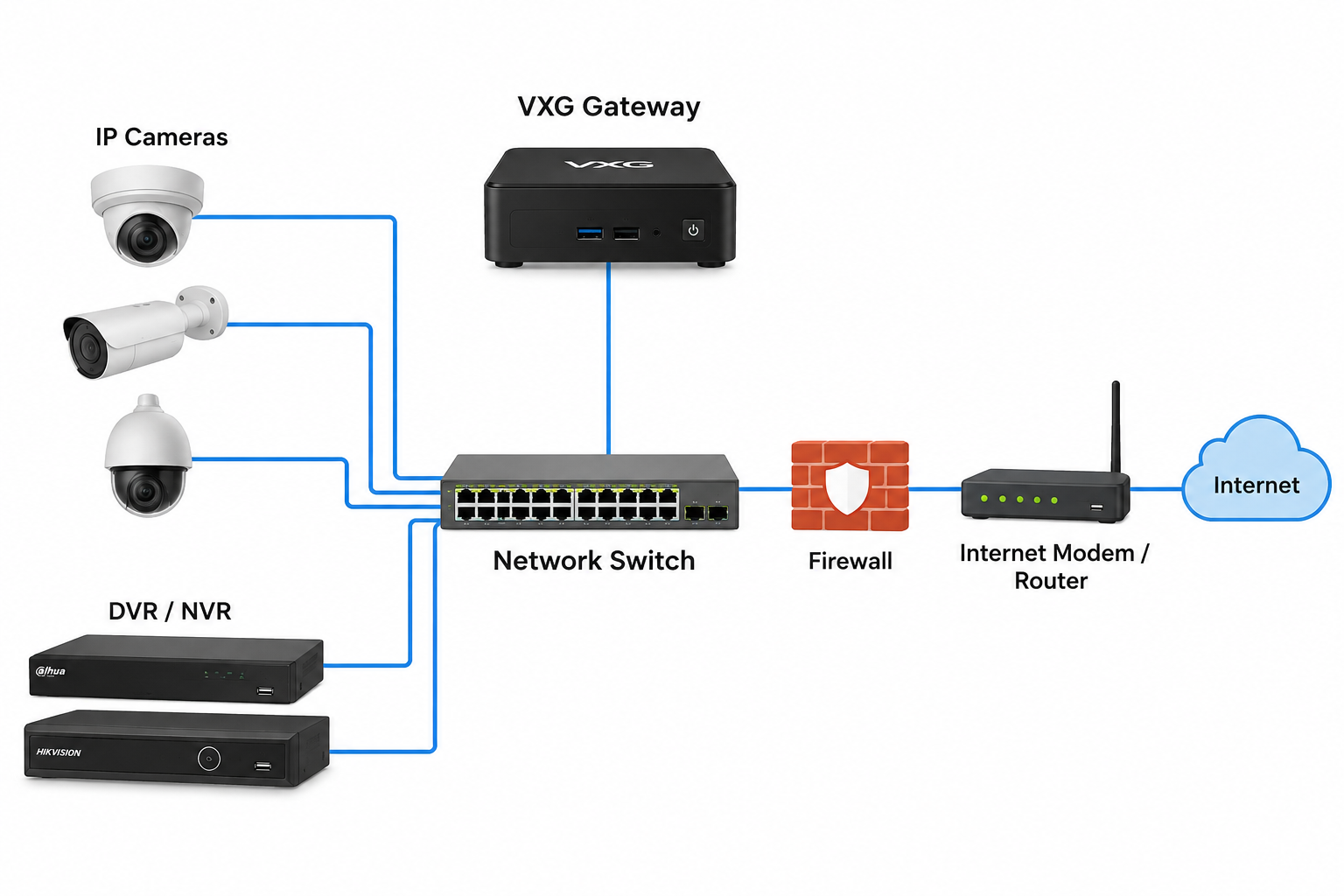
The Gateway provides access to supported camera features, including settings, web interfaces, and edge storage (SD cards), depending on the camera and integration. For further details, see Gateway compatibility and features.
Key Benefits
-
No camera modifications: Works with existing supported ONVIF or RTSP cameras.
-
Minimal network changes: No inbound port forwarding or VPN is normally required.
-
Flexible deployment: Runs on compatible routers, mini-PCs, and servers.
-
Remote access: Enables cloud access to supported camera functionality.
Outbound HTTPS on port 443 must be allowed, and the Gateway must have local network access to the cameras. Some environments may require IT configuration.
For more information, see Uplink Gateway documentation.
Supported Routers
-
GL.iNet GL-MT300N-V2 (Mango). Follow this page for GL.iNet router setup
-
Mikrotik hEX RB750Gr3.
Linux and Windows Systems
The Uplink Gateway is available as a Docker image for x64 and ARM64 architectures. A compatible Linux or Windows device with Docker is required.
System Requirements
For a basic four-camera deployment, the documented minimum requirements are a 500 MHz SoC, 128 MB RAM, and 250 KB of storage. Actual requirements depend on camera count and deployment configuration.
Hardware Examples
-
GL.iNET micro-router — indicative capacity of up to 8 cameras.

-
MikroTik routers, including PoE routers — indicative capacity of 8–16 cameras, depending on the model.

-
NucBox5 mini-PC — indicative capacity of up to 100 cameras.

Hardware capacities are indicative and should be verified for the intended workload. Contact VXG for assistance with larger deployments.