The system uses Generative AI to analyze and interpret video content based on your query.
-
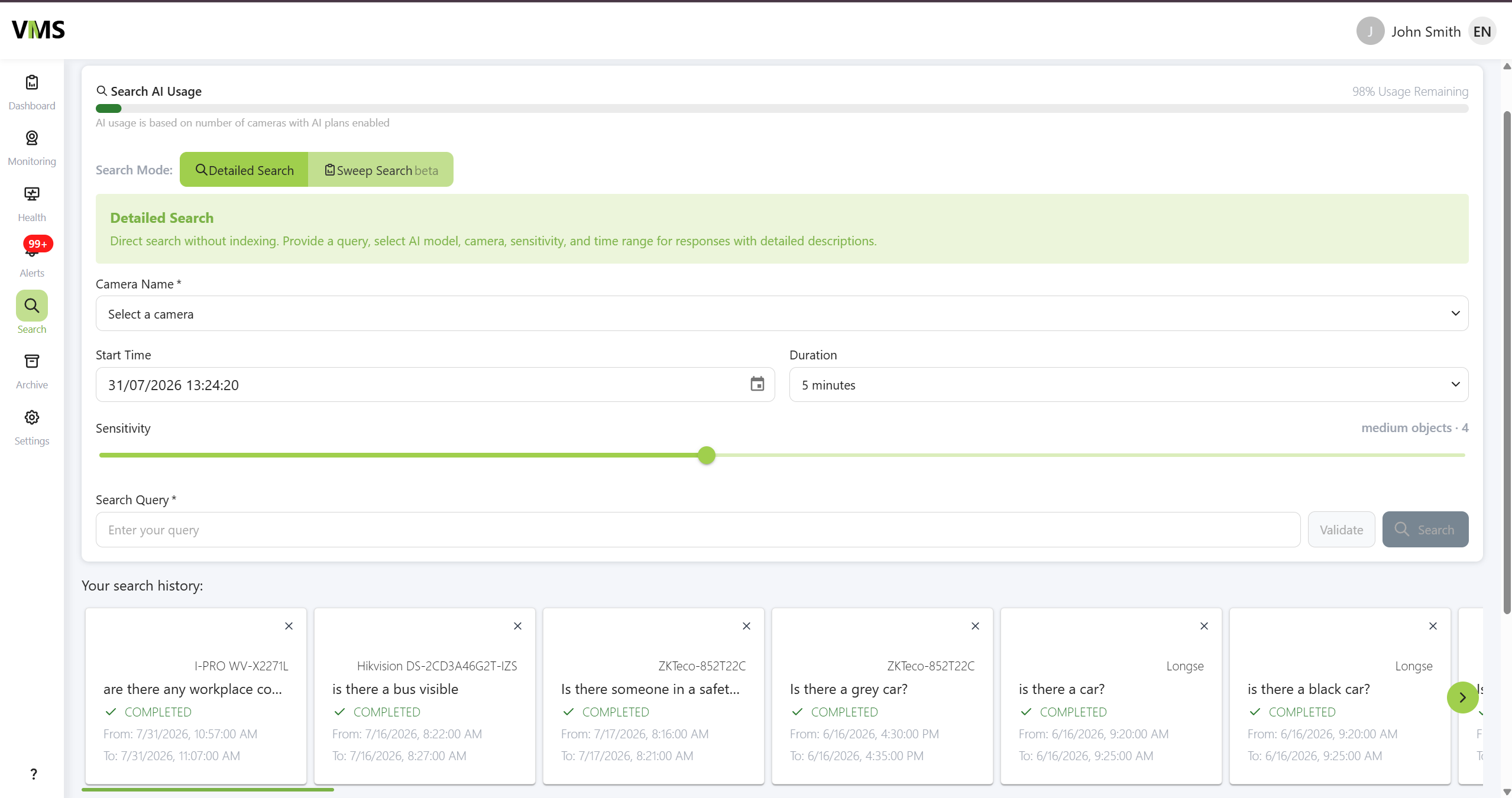
In the Search Query field, type a question or prompt in natural language.
Examples:
-
“Is there a FedEx truck?”
-
“Are there any safety concerns?”
-
Validation
The validation is used to assist you in making a prompt with the highest chance of giving you expected results. You must validate your prompt before being able to create your search.
How to write a valid prompt:
-
Make sure you phrase the prompt as a yes or no question. When the response is true, or yes, you can provide additional instructions. For example a valid prompt could be “Is any employee on the floor? If yes, count the ratio of employees to customers”
-
Don’t include anything that requires audio input or time ranges into your prompt. For example, an invalid prompt would be “How long has an employee been on the floor” or “Has there been any car sirens?”. Stick to single, visual questions like “Are there any delivery trucks?”.
Invalid prompt - If the prompt is deemed invalid, the system will give a reason and make a suggestion on how this prompt can be improved.
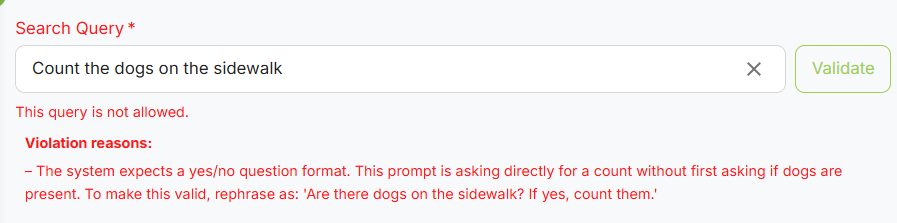
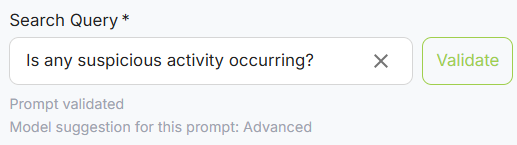
Valid prompt - It the prompt is deemed valid, the system will suggest the Advanced, Pro or Lite model based on the complexity of the prompt.
-
“Are any people on the sidewalk?” - Model suggestion for this prompt: Lite
-
“Are there any cars on the road? If yes, count them” - Model suggestion for this prompt: Pro
-
“Is any suspicious activity occurring?” - Model suggestion for this prompt: Advanced
Camera Selection
Select the appropriate camera by name from the dropdown menu. This limits the search to the chosen video source.
Sensitivity Settings
Adjust the Sensitivity level to control how much motion triggers Generative AI analysis.
-
1 – High sensitivity (detects small objects or subtle movements)
-
9 – Low sensitivity (detects only large objects or significant motion)
Choose a setting based on the expected size and movement of the objects you’re searching for.
Time Parameters
-
Start Time: Define when the search should begin in the video archive.
-
Duration: Specify how long the system should search from the start time (e.g., 30 minutes, 2 hours).
Viewing Results
Search results will appear as tiles at the bottom of the page. Each tile represents a video segment where potential matches were found.
-
Click on a tile to view a list of detected patterns that match your query.
-
All search results are stored for 1 week and can be revisited within that period.
-
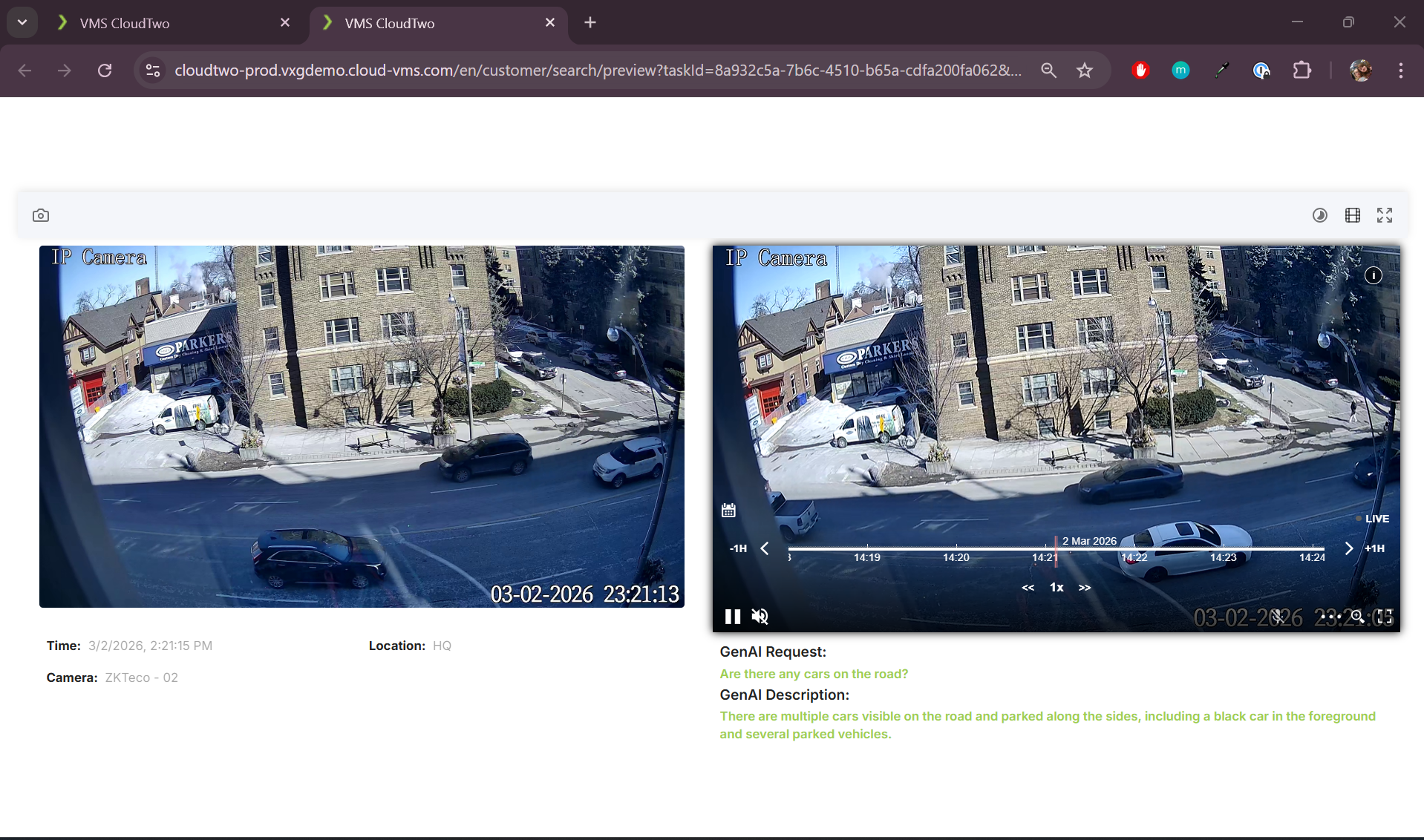
To view result in more detail click the “preview” button. This will open another tab with full size screenshot as well as a player set to the time the result was generated
Usage
Your search usage is displayed as a progress bar at the top of the Search page, with your current usage shown as a percentage.
The amount of usage consumed depends on the number of cameras connected to the system, the duration of each search, and the amount of motion detected in the camera scene. For example, a one-hour search on a camera monitoring a busy street will consume more usage than a five-minute search on a camera monitoring an empty office.
Your usage resets to 0% at the end of each month. If you reach your monthly search limit, contact your administrator to discuss increasing your allowance.
