Sweep search provides a way to use generative AI over longer periods of time than the detailed search. It indexes a time range you select for a camera and once a period is indexed, searching within it returns near-instant results. Sweep returns positive/negative matches only — it does not produce a written description of each hit.
When to use which search:
-
Sweep Search — Check long time ranges for whether something appears. Fast yes/no answers across hours or days, no descriptions.
-
Detailed Search — Ask about a shorter clip and get a detailed answer. Best for digging into a specific moment.
To run a Sweep search:
-
Open the Search page. If both search modes are enabled on your instance, switch the search card from Detailed to Vector/Sweep.
-
Select a camera. Indexes are per-camera, so the timeline stays disabled until a camera is chosen.
-
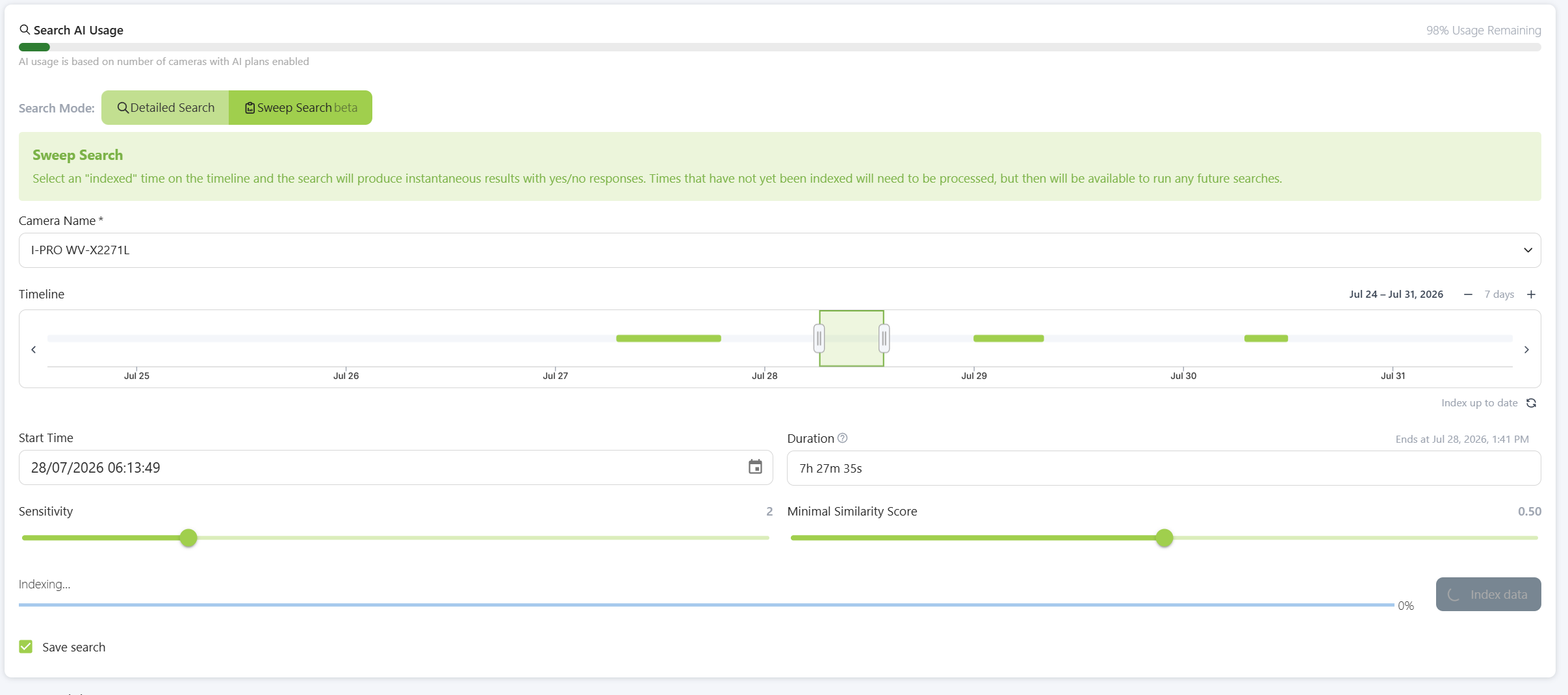
Wait for the indexed timeline to load. Highlighted sections are already indexed; blank sections are not yet indexed.
-
On the timeline, click a segment or drag-select a range (maximum 24 hours). This fills the Start Time and Duration fields automatically; editing either field moves the timeline, and vice-versa.
-
If you are selecting a time segment that isn’t highlighted, you will need to index this time before you perform any querys on it. This operation takes longer than the actual search, but once a time is indexed you will be able to perform near instantaneous searches on it going forward.
-
-
Optionally adjust Similarity score (how closely results must match your query) and Sensitivity.
-
Indexes are done based on sensitivity. By changing the sensitivity you will change the visible time indexes. However, different similarity scores can be assigned for different searches.
-
-
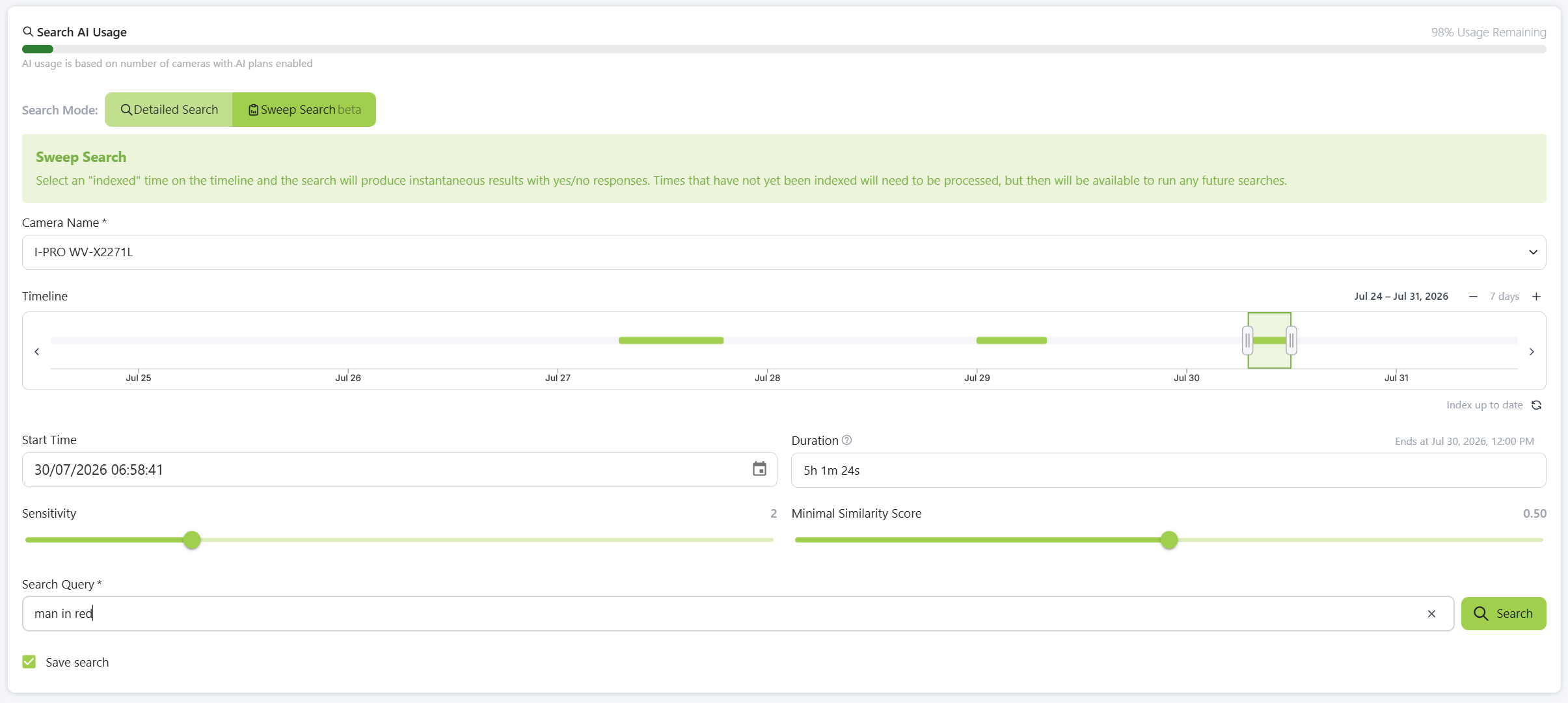
Type your query in the Search Query field in plain language. No validation step is required in Sweep.
-
Queries for sweep search must be short and simple queries with yes/no answers. Since sweep search does not provide descriptions for answers, there should be no additional instructions like we are able to add in a the detailed search mode
-
-
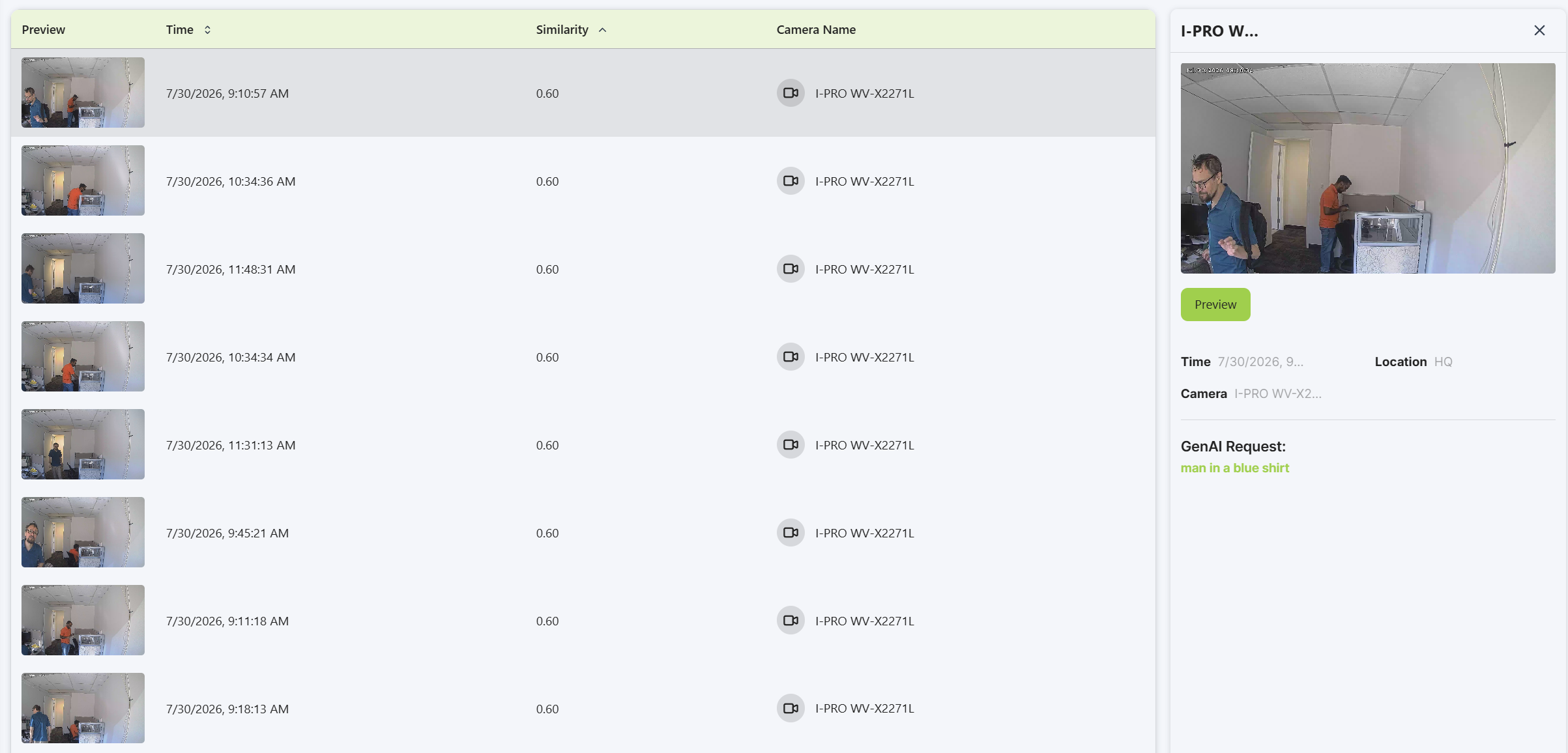
Run the search. Results appear as tiles/rows with preview, time, AI model, camera and site — with no description column.
-
By default, these results are sorted by time so you can see the the sequence of events from the camera. However, you can sort these results by “Similarity” by clicking the arrow besides the column title. The higher the similarity, the more accurate the result.
-